 Advertisement
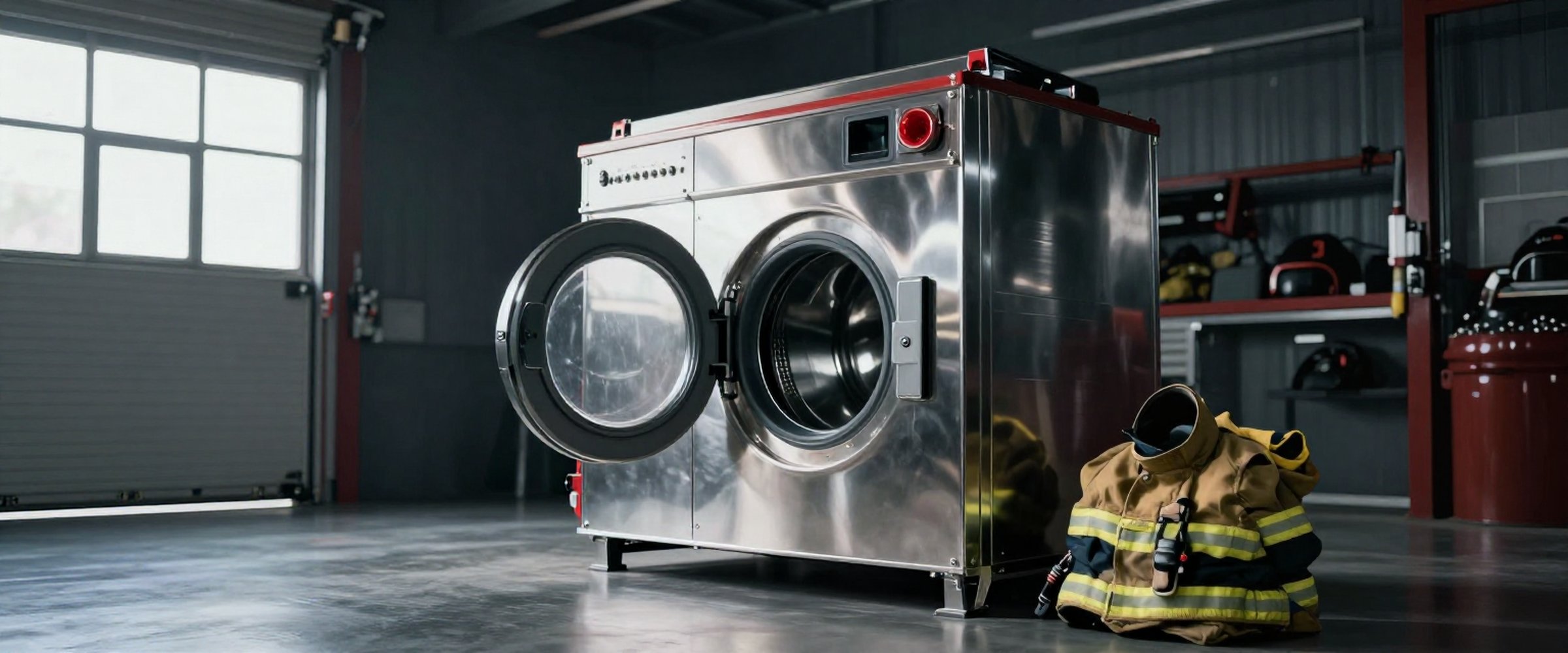
Wet washing is how most fire departments meet the advanced cleaning requirements of NFPA 1850: water, a detergent chemistry matched to the soil, and controlled mechanical action in a machine built for turnout gear rather than for laundry.
This page is sponsored by Circul-Air Corp. Sponsorship pays for the page; it does not decide what it says, and the equipment described here is assessed on the same terms as anything else on this site.
Why a washer-extractor and not a washing machine
Turnout gear is a three-layer system (outer shell, moisture barrier, thermal liner) assembled with seams, reflective trim, hardware and closures that all have to survive the wash. A domestic or commercial laundry machine treats it as fabric. A washer-extractor built for PPE controls the variables the standard cares about: water temperature held below the point where the moisture barrier is damaged, mechanical action strong enough to lift embedded particulate but gentle enough not to abrade trim, and a controlled extract speed that removes water without stressing seams.
The two mounting types are worth understanding before you buy. A soft-mount extractor carries its own suspension, so it can run high extract speeds on an ordinary floor without a concrete plinth, which is what makes it practical to retrofit into an existing station. A hard-mount machine has to be bolted to a reinforced foundation, which usually means construction.
Circul-Air Corp
Circul-Air Corp builds gear care equipment specifically for the fire service rather than adapting industrial laundry hardware to it. The washing side of the range runs from compact Express soft-mount extractors sized for a single station (roughly 22 to 35 lb, four to seven pieces of gear per load) up to heavy industrial soft-mount machines at 90 and 130 lb for a department or regional facility processing eighteen to twenty-six pieces at a time.
Around the extractor sits the rest of what a care program needs: detergents formulated for the job rather than borrowed from another industry, including a citrus-based PPE cleaner, a biological-cycle detergent for the cycles that call for one, and a low-suds cleaner for SCBA. Drying cabinets and tumble dryers close the loop, and a rotary washer handles the hard goods (SCBA, boots and helmets) that cannot go through a gear extractor at all. That last point matters more than it used to: NFPA 1850 now covers SCBA alongside the ensemble, so the breathing apparatus needs a documented cleaning path too.
The wastewater question
Washing gear moves contamination off the garment. It does not make it disappear; it puts it in the water, and PFAS in extractor discharge is under tightening regulatory scrutiny at both local and federal level. A department that has solved its cleaning problem has not automatically solved its discharge problem.
Circul-Air’s answer is DEXSORB, a filtration system designed for PPE washer-extractor wastewater that targets both long-chain and short-chain PFAS before the water reaches sewer or septic. It is NSF/ANSI 61 certified, sized to fit station spaces, and offered on a subscription that covers media replacement, disposal and the compliance documentation. Practically, it also needs planning: a pre-site evaluation, a licensed plumber or public works crew for installation, and in most cases a drain trough and sump arrangement to collect the water in the first place.
Find out more
Circul-Air publish their extractor, dryer, detergent and filtration ranges with specifications and current pricing, along with reference material on the NFPA 1850 cleaning and inspection requirements.
The alternative approach, using liquid carbon dioxide as the solvent instead of water, is covered on the Liquid CO2 technology page.
General information for fire service decision makers. Product specifications, capacities, certifications and pricing change; confirm current details with the manufacturer, and confirm that any cleaning process you adopt meets NFPA 1850 as your authority having jurisdiction has adopted it.
 Advertisement