 Advertisement
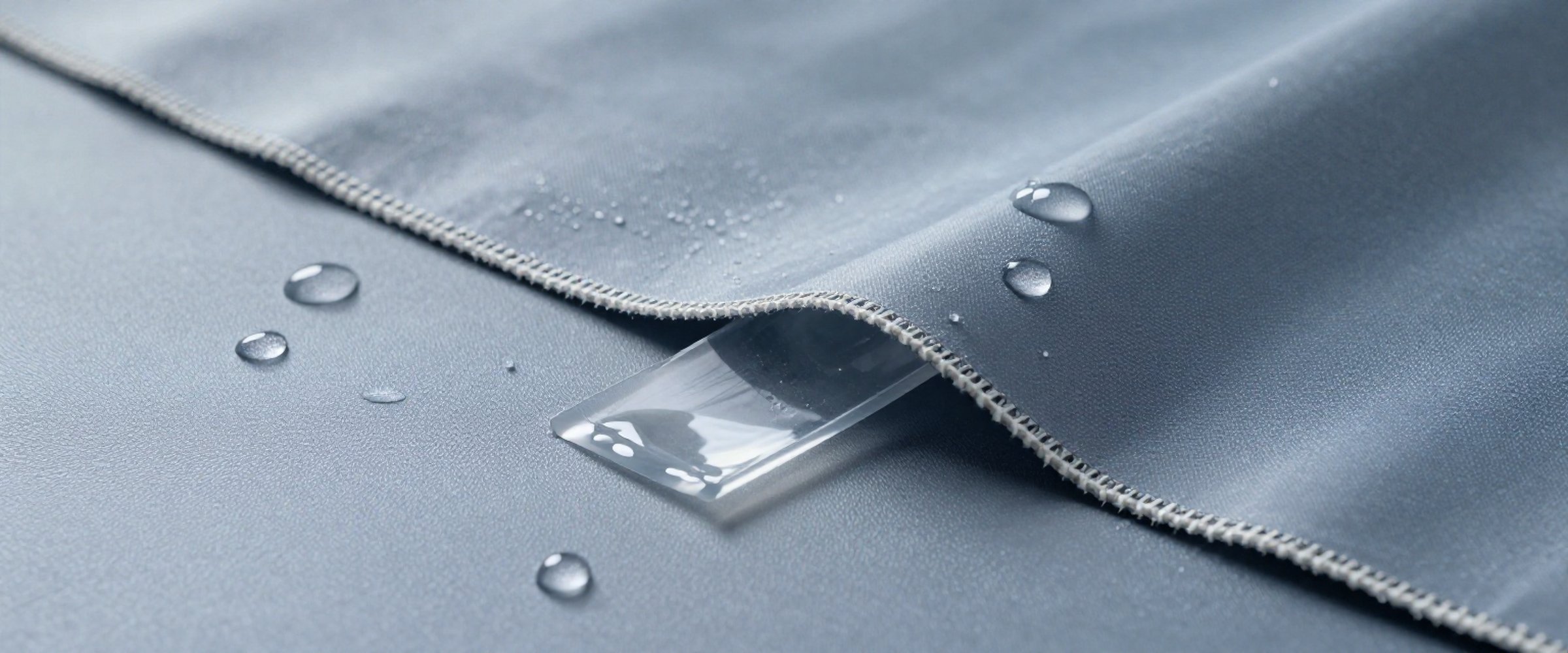
The moisture barrier is the thinnest layer in the ensemble and the one with the most asked of it. It has to stop water, blood and chemicals getting in while letting the firefighter’s own perspiration vapor get out, two demands that pull against each other, and it has to keep doing both after heat, flexing, laundering and years of service.
It is also the layer a department is least likely to inspect, because it is buried. That combination, high demand and low visibility, is why the barrier drives so much of what the standard now asks for.
What it is made of
A moisture barrier is not a fabric in the ordinary sense. It is a film or membrane laminated to a substrate: the functional layer does the barrier work, and the substrate carries it and gives it something to be sewn into. When people talk about a barrier’s performance they usually mean the film; when they talk about its durability they usually mean the laminate as a whole.
The functional polymer has historically been expanded polytetrafluoroethylene (ePTFE), which is exceptionally good at exactly this job: it repels liquid water from outside while remaining open to water vapor from inside. Barriers that do not rely on ePTFE reached the market from 2024 onward, and more are expected as suppliers work through the change described below.
Seams matter as much as the material. A barrier is only a barrier if its seams are too, which is why the standard tests seams alongside the material rather than treating them as a construction detail.
What it has to keep out
The barrier is what stands between your members and the liquids on a fireground or a roadway: water, but also blood and other body fluids, and the run-off and chemicals that come with vehicle and industrial incidents. Under NFPA 1970 a manufacturer can demonstrate that in one of two ways.
- The viral penetration resistance test, carried over from NFPA 1971, which remains available.
- A liquid barrier performance option introduced by NFPA 1970, in which the barrier and its seams must meet the Level 3 barrier requirements of ANSI/AAMI PB70, tested by AATCC 42 for water resistance under impact penetration and AATCC 127 for water resistance under hydrostatic pressure.
The practical point for a department is simply that two certified barriers may have been qualified by different routes. If liquid protection is a live concern for the work you do, ask which test the composite was qualified under rather than accepting “it’s certified” as the end of the conversation.
How NFPA 1970 changed the testing
The barrier requirements were tightened in ways that all move in the same direction: test the material the way it actually lives, inside a garment, rather than on its own on a bench.
- UV degradation is now assessed in composite form. The barrier is exposed to ultraviolet light as part of the composite, and its water resistance is then evaluated after exposure from both the outer shell side and the thermal barrier side, a closer simulation of what light and heat reach it through the layers around it.
- Heat and thermal shrinkage resistance are now tested in composite form after laundry conditioning and heat exposure. That is a deliberate move toward real-world condition: a barrier is judged after it has been washed and heated, not while new.
If your department is replacing gear certified to an older edition, this is one of the more meaningful differences behind the same word “certified.”
Why it is the most fragile layer
The barrier is the layer improper care damages first, and the damage is not visible from outside the garment. Heat is the main enemy, including the heat of an over-hot drying cycle, not only fireground heat. Repeated hard folding along the same line works a film. Abrasion from grit trapped between layers works it too. Cleaning chemistry the barrier was never designed for can take it apart quietly.
None of that shows on the outside of a coat, which is exactly why the standard’s advanced inspection opens the garment and looks at the barrier directly, and why a light-evaluation or leak check is part of a serious care program rather than an optional extra. A shell with a good barrier behind it is protective clothing; the same shell with a failed barrier is a heavy jacket. See cleaning and care and independent service providers.
PFAS, and why nothing is labeled “PFAS free”
PFAS reached turnout clothing by two routes. It was used as a durable water repellent on outer shells, on some barriers and on a few other components, a use that suppliers and garment makers have largely phased out over recent years. And it was the backbone functional polymer of the barrier film itself, in the form of ePTFE, which is the harder problem and the reason the barrier sits at the center of this question.
NFPA 1970 addresses it in two ways. Material and component suppliers must have their materials independently tested for certain PFAS chemicals, and a manufacturer may only use materials shown to be absent of them or to hold them at very low levels; this part is mandatory, and it applies whether or not the manufacturer says anything on the label. Separately, an optional label lets a manufacturer state that the certified item holds a total fluorine concentration no greater than 100 parts per million.
That optional label deliberately does not say “PFAS free,” and the reasons are worth understanding before you write the phrase into a specification:
- There is no single method that can measure all of the many thousands of PFAS chemicals. Total fluorine is used as a proxy, measured by combustion ion chromatography, which burns the sample and counts fluorine atoms.
- That proxy over-reports. Not all fluorine in a sample is PFAS, so the number is a ceiling rather than a measurement of what is actually there.
- PFAS contamination is ubiquitous at very low levels, reaching products through raw materials, process water and machinery without ever being added deliberately. “Free” would be a claim no one could stand behind.
- The scope is partial. The requirements focus on the major textile-based materials in each element of the ensemble; some materials, including leather and certain plastics, are excluded because methods to characterize them are not yet established.
The 100 ppm figure is not arbitrary: it tracks California’s limit on total organic fluorine in apparel, which took effect in 2025 and is set to fall to 50 ppm in early 2028. Departments in states with their own PPE disclosure or restriction laws should read those alongside the standard rather than instead of it.
The honest summary is that a manufacturer may still sell PFAS-containing products, that some substances are now held to very low levels, and that a non-PFAS claim can only be made where it has been demonstrated. What actually changed is accountability: suppliers are now independently verified as part of certification rather than taken at their word. PFAS is also only one category; NFPA 1970 brought in limits on hundreds of other restricted substances, verified the same way through an attestation certificate the end manufacturer has to hold.
Status as of August 2026. PFAS regulation is moving quickly at state level and the material market is changing with it. Confirm the current position, the edition your authority having jurisdiction has adopted, and your own state’s requirements before relying on any of this in a specification.
This page describes barrier technology and the shape of the standard in general terms. It names no manufacturer and endorses no barrier. Certification belongs to the composite: a barrier’s figures describe it in the combination it was tested in. See what NFPA 1970 requires.
The other two layers
Outer Shell
Takes the flame, the abrasion and the UV, carries the trim, and supplies most of the garment’s strength; fiber, yarn and weave each change it independently.
Thermal Liner
Most of the insulation, most of the bulk, and the layer where the TPP against THL trade-off is actually decided.
General information for fire service decision makers, not a specification and not compliance advice. It names no manufacturer and endorses no fabric. NFPA and the standards referenced here are the property of the National Fire Protection Association; FireBrigade.com is not affiliated with, endorsed by, or speaking for NFPA.
 Advertisement