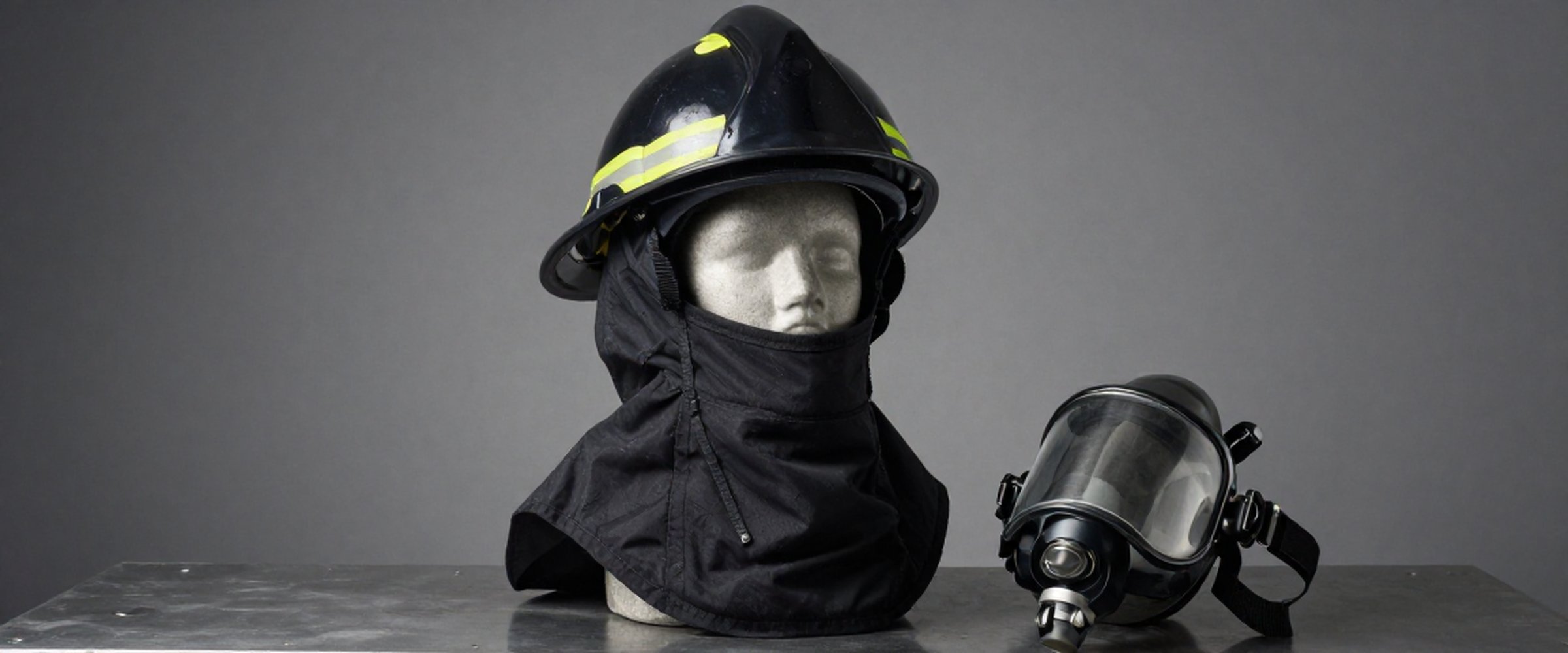
The hood is the cheapest element of the ensemble and the one that changed the most. It protects the head and neck, and it is what closes the gap between the coat collar, the helmet earflaps and the SCBA facepiece. That gap sits directly over the skin that absorbs contaminants fastest, which is why the standard moved.
A knit hood is no longer a compliant hood
This is the change to act on. Particulate-blocking hoods appeared as an optional certification in the 2018 edition of NFPA 1971: a department could buy one, but the standard did not ask for it. Under NFPA 1970, particulate blocking is mandatory for every structural firefighting hood. A traditional knit hood with no particulate barrier is no longer a compliant structural hood.
That has a practical consequence for anyone with stock on a shelf. Knit hoods already in service were compliant when they were made and are governed by the care and retirement rules like any other element, but they are not what you can specify now. If your last hood order predates the change, the next one will not look like the last one, and it will not cost what the last one cost.
What “particulate blocking” has to do
The term describes a measured performance, not a marketing category. A structural hood has to filter at least 90 percent of particles between 0.1 and 1.0 micron. Three details around that number are where hoods differ from one another:
- It is tested through the composite, including the seams, not on a swatch of the base fabric. A hood is a sewn assembly, and a seam that leaks is a leak.
- The blocking layer has to run through the whole hood, not only the panel over the face and neck. Partial coverage was possible under the optional scheme and is not what the current requirement describes.
- It is a filter, not a seal. Blocking is measured across the material. It says nothing about what passes through the opening around the facepiece, which is a fit question and belongs to whoever dons the hood.
Breathability is part of the requirement, deliberately
Adding a barrier layer to a hood risks trading a contamination problem for a heat stress one, and the standard addresses that head on. A structural hood must reach a total heat loss of 325 W/m². For comparison, the minimum THL for a garment composite is 205 W/m², so the hood is held to a higher breathability bar than the coat it tucks into.
That is the right instinct. The head sheds a large share of the body’s heat, and a hood that blocks particulates by simply being denser would raise the routine risk your members face on every call in order to reduce an exposure risk. If you are comparing hoods, THL is the number that tells you whether a maker solved the problem or dodged it.
The interface is the whole point
A hood is not judged on its own. It is judged on how it sits against three other things:
- The SCBA facepiece. The face opening surrounds the facepiece and is held by an internal elastic tensioned to close around it without making the hood impossible to pull on. Where a hood is sized to a particular facepiece, the opening is required to overlap it by at least half an inch. This is the interface most often lost, because it is the one that moves every time a firefighter turns their head.
- The helmet earflaps. The hood and the earflaps together cover the ears and neck. Earflaps left flipped up quietly remove protection the certification assumed was in place.
- The coat collar. The bib has to be long enough to stay under the coat through head and neck movement, and the standard sets a minimum bib length and minimum face-opening dimensions for that reason. The bib only works fully tucked under the coat with the collar raised. A bib worn outside the collar is a decorative one.
Fit and sizing
Hoods must now be offered in multiple sizes covering the 5th to 95th percentile, which ends the one-size-fits-all assumption that never fitted the smallest or largest members of a department. Sizing is not a comfort feature here: the opening tension and the bib length are what hold the interfaces above, and both depend on the hood actually fitting the head it is on.
Evaluate a candidate hood with your own issued facepiece and helmet, on the members who will wear it, and check that the overlap at the collar and the seal area around the facepiece hold through normal head movement rather than only when standing still.
Care, and the ten year clock
Hoods are laundered far more often than the rest of the ensemble, so cleaning is where their performance is won or lost. The certified properties include cleaning shrinkage and heat shrinkage resistance, burst and seam strength, and retention of the hood opening size, which tells you what the standard expects laundering to threaten: a hood that has shrunk, or whose opening has stretched out, no longer holds the interfaces it was certified with.
- Follow the manufacturer’s instructions rather than the department’s habit. Where a dryer is used, that generally means a no heat or air setting, or a low setting that does not exceed about 105°F.
- Do not dry hoods in sunlight. Several hood materials degrade under ultraviolet exposure, and the damage is invisible.
- NFPA 1850 carries inspection protocols specific to particulate-blocking hoods. Inspecting one like a knit hood misses what you are now paying for.
Retirement is the same clock as the rest of the ensemble: ten years from the date of manufacture, not from the date it was issued. See cleaning and care and independent service providers.
On PFAS labeling
Hoods sit against the skin for the whole of a working shift, so the PFAS question gets asked about them more than about any other element. A hood may be labeled as containing no intentionally added PFAS where its total fluorine content is below 100 parts per million. Read that as what it says: a threshold on a measurement, and a statement about intent. It is not a certification that a product is free of these substances, and nothing is labeled that way. The wider picture is set out on the moisture barrier page.
What to ask a supplier
- What is the total heat loss of this hood, and how does it compare with the others you sell?
- Was the filtration figure measured through the finished composite including seams, and does the blocking layer run through the entire hood?
- Which sizes do you offer, and which facepiece was this hood designed around?
- What are your laundering instructions, how many cycles is the hood expected to hold its opening size for, and what does your warranty say about shrinkage?
- Where is the date of manufacture on the label, and how old is the stock you would ship us?
- Is this hood labeled as containing no intentionally added PFAS, and on what basis?
This page describes hood technology in general terms and names no manufacturer. Materials, constructions, sizing and test values vary between makers and between models from the same maker, so ask any supplier for the figures on the certified product you would actually buy.
A hood is certified as a finished product, and much of what it does depends on the elements it meets. Its protection is only as good as the interfaces with the helmet, the coat collar and the facepiece your members actually wear. See protective apparel for how the ensemble is certified as a system.
Related
Helmets & Eye Protection
The other half of the head and neck interface, including the earflaps the hood is designed to work with, and why a faceshield is not primary eye protection.
Coat & Pant
The garment the bib tucks into, its three certified layers, and the total heat loss figure the hood is measured against.
General information for fire service decision makers, not a specification and not compliance advice. It names no manufacturer and endorses no product. NFPA and the standards referenced here are the property of the National Fire Protection Association; FireBrigade.com is not affiliated with, endorsed by, or speaking for NFPA.