 Advertisement
Liquid carbon dioxide cleaning takes a different route to the same destination as a wet wash: it replaces water and detergent with CO2 held as a liquid under pressure, and it runs without heat and without leaving the gear wet.
This page is sponsored by Cool Clean Technologies. Sponsorship pays for the page; it does not decide what it says, and the equipment described here is assessed on the same terms as anything else on this site.
How it works
Carbon dioxide is a gas at room temperature and ordinary pressure. Put it under enough pressure and it becomes a liquid, one with a much lower viscosity and surface tension than water. That difference is the whole point of the process. Water can wet the outer shell of a turnout coat readily enough, but the moisture barrier exists precisely to stop liquid water passing through it, which is a problem when the contamination you are chasing has already worked its way inside. Liquid CO2 moves through outer shell, moisture barrier and thermal liner because the barrier is not designed to stop it.
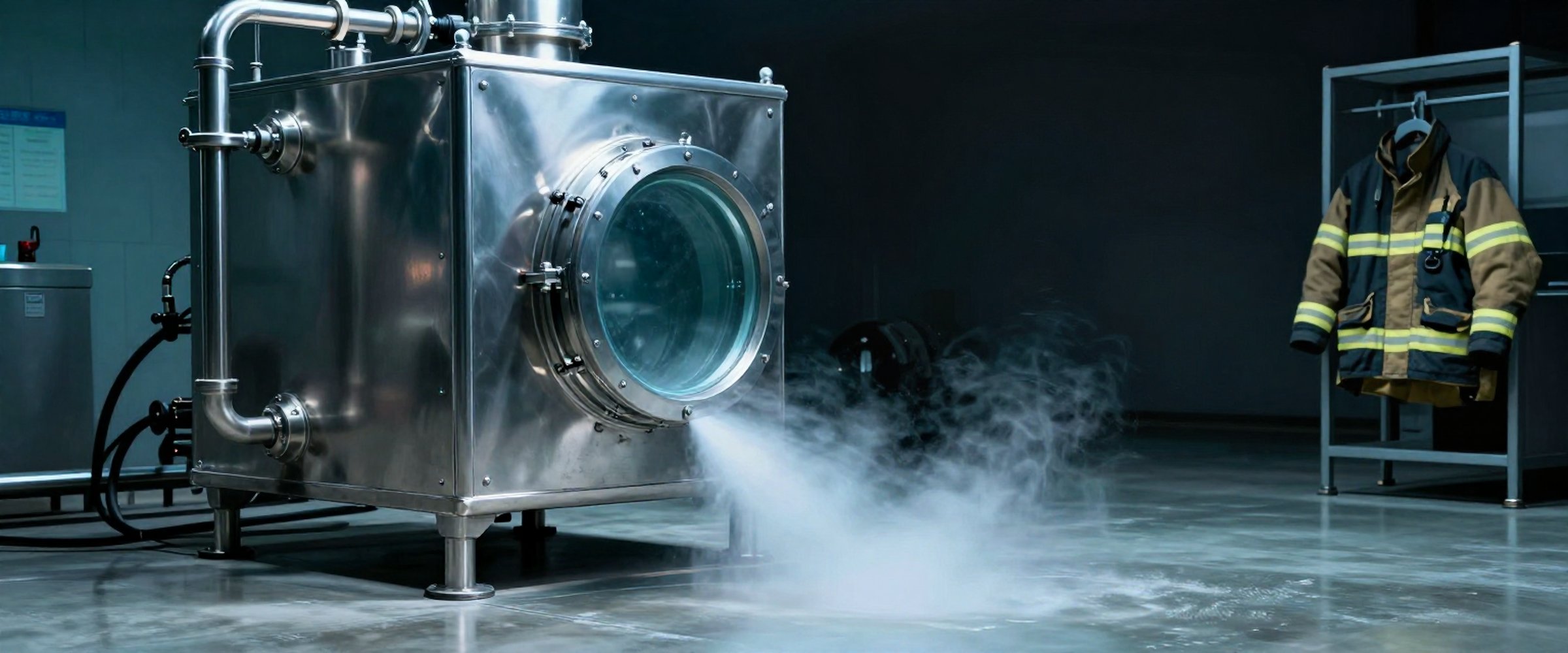
The gear goes into a sealed pressure vessel rather than a drum open to the room. The CO2 is introduced as a liquid, circulated as the cleaning solvent, then recovered when the cycle finishes and the vessel returns to atmospheric pressure. What is left in the chamber is dry gear.
What that changes operationally
- No drying stage. The CO2 evaporates off the garment as the vessel depressurizes, so the gear comes out ready to inspect. A wet wash has to be followed by hours in a drying cabinet before the gear is back in service.
- Room temperature throughout. The process does not heat the ensemble, which removes one of the variables a wet wash has to control carefully.
- Cycle times of roughly 40 to 70 minutes, according to Cool Clean, with no drying time added on the end.
- No wash water. Nothing goes down the drain, so there is no extractor discharge to filter and no PFAS-in-wastewater compliance question attached to the cleaning step.
- A pressure vessel in the building. The trade-off is a system with a CO2 supply and pressurized equipment, which is a different siting, servicing and training proposition from a washer-extractor.
Cool Clean Technologies
Cool Clean Technologies, based in Eagan, Minnesota, has been developing CO2-based cleaning systems for more than twenty years, with patents and installed equipment in medical device manufacturing, automotive, aerospace and electronics. Fire service turnout gear decontamination is an application of that existing technology rather than a one-product company, which is worth knowing when you are assessing whether the engineering behind a machine is mature.
Their fire service case rests on firefighter occupational cancer: contaminated gear traps combustion products, and anything that removes more of them from all three layers reduces what a firefighter is exposed to between calls. That framing is consistent with what is on our Health & Wellness pages, whatever cleaning method a department chooses.
Find out more
Cool Clean publish their fire service material, including their own testing claims and equipment details, on their site.
The established water-based approach is covered on the WetWash technology page.
General information for fire service decision makers. Comparative cleaning-performance figures published by equipment manufacturers have not been independently verified by FireBrigade.com and are not reproduced here; ask any vendor for the underlying test method, laboratory and sample set before you rely on a percentage. Confirm that any cleaning process you adopt meets NFPA 1850 as your authority having jurisdiction has adopted it. Cool Clean Technologies is an unaffiliated third party.
 Advertisement