 Advertisement
The helmet is the element your members put on for every call, the one most visible to the public, and the one most often chosen on tradition rather than on specification. It is also two products in one. Head protection and eye protection are certified together, cared for together and retired together, and the eye protection half is where departments most often fall short without knowing it.
Which standard applies now
Helmet design and performance requirements used to sit in NFPA 1971. They now sit in NFPA 1970 (2025), which consolidated the ensemble standard together with work apparel, SCBA and PASS into one document. Products manufactured after September 28, 2024 are built to NFPA 1970. Anything already in your inventory was certified to the edition current when it was made, and it stays compliant on its own terms, so a consolidation is not a reason to replace a helmet.
Two changes at the helmet are worth knowing when you read a new spec sheet: the minimum chin strap width increased to five eighths of an inch, and key identification information now appears on a separate internal label. Neither changes how a helmet performs, but both change what you are looking at when you compare a current model against one bought five years ago.
Eye protection: the part that gets missed
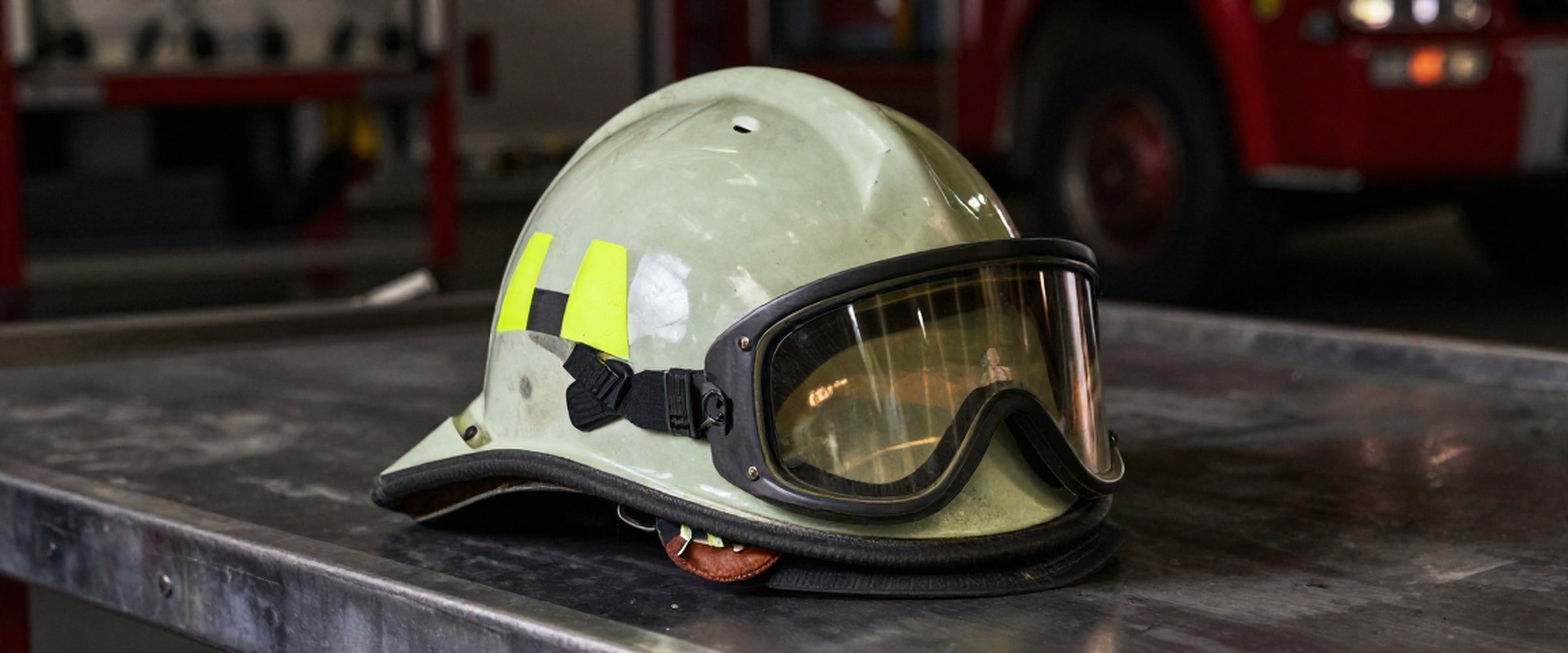
This is the single most useful thing on this page. A helmet is supplied with a faceshield, or goggles, or both, and whichever components come with it must also comply with ANSI Z87.1, the occupational eye and face protection standard. Compliance with Z87.1 is not the same as being primary eye protection.
Under the Z87.1 framework, a faceshield is secondary protection. It is designed to be worn over primary eye protection, not instead of it. Goggles are primary protection for the hazards that actually take firefighters’ eyes: flying particles during overhaul, splash during extrication, and body fluids on EMS calls. A member working with the faceshield down and nothing behind it has secondary protection only.
That is not a defect in the faceshield, which does useful work against radiant heat and debris arriving at the face. It is a question of what you issued and what your members put on. If your helmets carry a faceshield and no goggles, the gap is worth closing before the next specification cycle rather than after an injury report.
What is actually in a helmet
- The shell. Takes impact, penetration, flame contact and radiant heat. Thermoplastic and composite shells both meet the standard and age differently; ask how each behaves after years of ultraviolet and thermal exposure, not just how it tests new.
- The impact cap and energy absorbing liner. The parts that manage a blow. They are inside the shell, invisible in a showroom comparison, and they are most of the reason a helmet works.
- The suspension and headband. What holds the helmet in position and sets how the load sits on the head. Adjustment range matters because the helmet has to fit over a hood and around an SCBA facepiece.
- Ear covers. Protect the ears and neck. They are also the component most often left flipped up or torn off, which quietly removes protection the certification assumed was there.
- The chin strap. A helmet that is not retained is a helmet that leaves at the worst moment.
- Retroreflective marking. Part of being seen, and part of the same visibility question covered on firefighter visibility.
Weight, balance and the neck
Traditional helmets with front and rear brims are heavier than low-profile designs, and the brims catch on things in confined space. Low-profile designs are lighter and cleaner in a hole, and they have never displaced the traditional helmet in the American fire service, largely for cultural reasons rather than technical ones.
Weight is the obvious number and it is not the whole story. Balance is what the neck feels. Biomechanical work on helmet design points toward a lower center of mass improving neck range of motion and reducing the potential for neck injury, and a top-heavy helmet produces fatigue at a given weight that a well-balanced one does not. When you evaluate, ask for the mass and then have members wear the candidates through a full evolution with a facepiece on, because the specification sheet cannot tell you where the weight sits.
The cultural point is a real selection factor, not a distraction. A helmet that members accept and wear correctly, with the ear covers down and the chin strap fastened, protects better than a technically superior helmet they resent.
The ten year clock
Care, inspection and retirement for the whole ensemble sit in NFPA 1850, the 2026 consolidation of NFPA 1851 and 1852. Mandatory retirement was introduced in the 2008 edition of 1851 and has not softened since: every element of the ensemble, the helmet included, comes out of service ten years from the date of manufacture.
Two details decide whether a department gets this right. The clock runs from date of manufacture, not date of issue, which is on the product label and is often a year or more before the helmet reached your members. And a helmet leaves service immediately after a substantial impact, whether something struck it or the wearer went down on it, regardless of how new it is. Damage that matters can be invisible from outside, because it happened in the energy absorbing liner.
Between those two events, a helmet is inspected and cleaned on the same documented program as the rest of the ensemble. See cleaning and care and independent service providers.
What to ask a supplier
- Which eye protection components does the certified product include, and are goggles part of the price or an accessory line item?
- What is the mass of the helmet as we would issue it, with every component we intend to fit?
- What adjustment range does the suspension give, and has this helmet been evaluated with the hood and facepiece we already use?
- Which parts are user replaceable, which require a verified service provider, and what does a replacement faceshield, ear cover set or suspension cost?
- Where is the date of manufacture on the label, and what is the age of the stock you would ship us?
- What does the manufacturer require us to do after an impact, and who makes that call?
This page describes helmet technology in general terms and names no manufacturer. Shell materials, suspensions, masses and component availability vary between makers and between models from the same maker, so ask any supplier for the figures on the certified product you would actually buy.
Certification belongs to the helmet as a certified product, with its components. Fitting a faceshield, goggle or suspension that was not part of that certification means the label no longer describes what your members are wearing. The same principle governs the turnout composite: see coat and pant.
Related
Coat & Pant
The turnout ensemble and the three layers it is built from, and why certification belongs to the composite rather than to any one layer.
Cleaning of PPE
What NFPA 1850 asks of a care program, and why the helmet is on it like every other element.
General information for fire service decision makers, not a specification and not compliance advice. It names no manufacturer and endorses no helmet. NFPA and the standards referenced here are the property of the National Fire Protection Association; ANSI Z87.1 is the property of the American National Standards Institute. FireBrigade.com is not affiliated with, endorsed by, or speaking for either.
 Advertisement