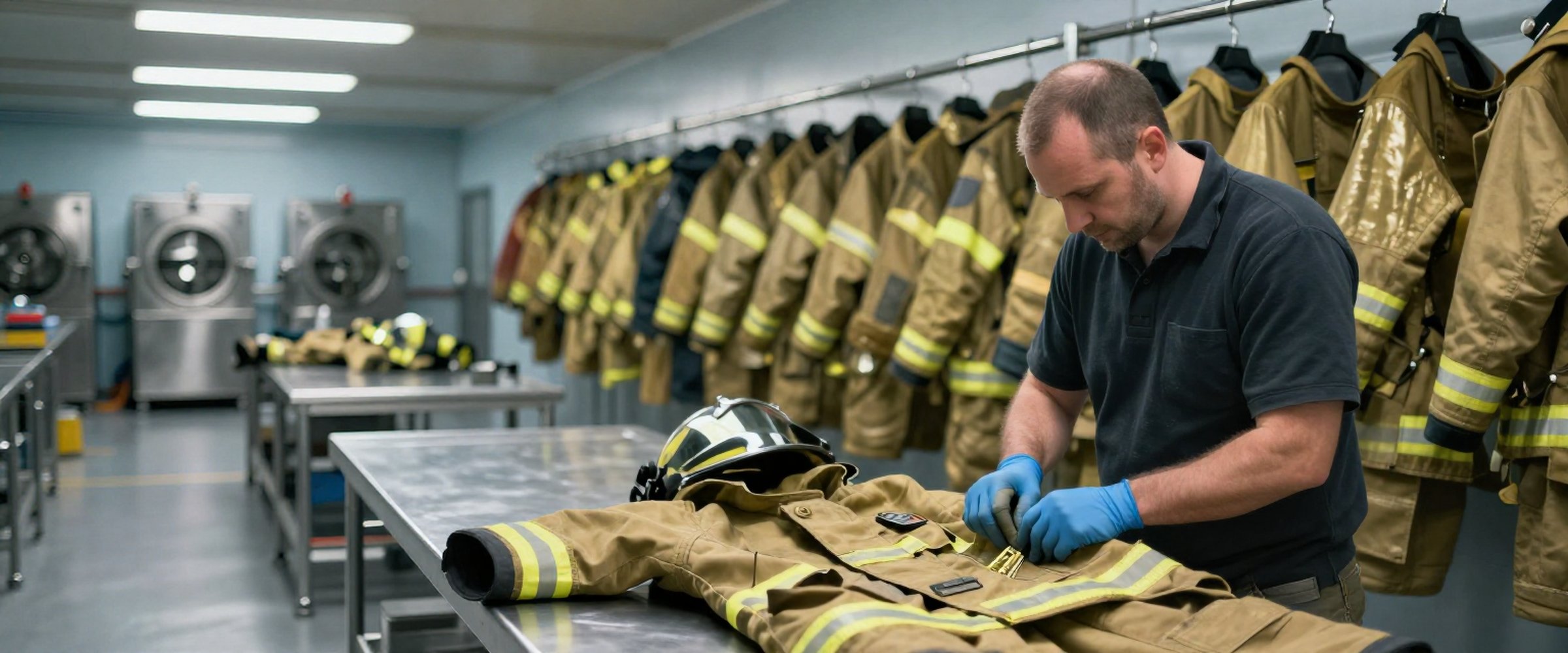
A care and maintenance program is a lot of work for a department to stand up on its own. An independent service provider – an ISP is a third party that cleans, inspects, repairs and documents protective clothing to the requirements of NFPA 1850, and can carry as much or as little of that program as a department wants it to.
This page is a follow-up to Cleaning of PPE, which sets out what the standard asks a department to have in place. What follows is about who does the work.
What an ISP is, and what “verified” means
An ISP is not simply a commercial laundry, and verified is not a word a provider gets to apply to itself. Under the standard it is a defined status, granted by an independent third-party certification organization that tests how well the provider actually meets the requirements – UL and Intertek both run such programs – and a verified provider carries that body’s mark. A provider’s own laboratory results, or a detergent supplier’s test data, are not the same thing. Ask who issued the verification, and check it.
The trap is that verification comes in scopes, and they are not interchangeable. The narrowest is a verified cleaner, which covers advanced cleaning and sanitization and nothing else: a provider holding only that verification cannot perform your advanced inspections or repairs in a way that complies with the standard, however capable it may be at the work. Full-service verification covers every service the standard defines. So the question is not only “are you verified” but “verified for what” – and it needs to match the list of things you are asking them to do. A department can also put its own organization through verification to service its own gear, which is worth knowing if the long-term plan is to bring the work in house.
The other thing an ISP brings is breadth. A department sees its own gear. An ISP sees every make and model in circulation, and has direct experience of how different specifications clean, wear and repair over a service life. That is knowledge a single department cannot accumulate on its own.
Three ways to use one
The decision is not “do it ourselves or hand it over”. There are three workable arrangements, and the right one depends on the department’s resources, budget and appetite for running the program itself.
- Help us start. The ISP educates the department on what the standard requires, helps build the program, and then steps back. The department runs it.
- Supplement what we already do. The department handles routine work and some advanced cleaning; the ISP takes the specialized cleaning, the repairs, or the advanced inspections that need an outside eye.
- Run it for us. The ISP carries the cleaning, inspection, repair and record keeping end to end.
Deciding which of these you are buying is the first conversation to have, because it determines everything else – what equipment the department needs, who has to be trained, and what the contract is actually for.
Where an ISP can carry the load
Selection and specifications
The care requirements only make sense once the right ensemble has been chosen, and that choice should follow from a risk assessment of what the department actually responds to – not from what a larger neighboring department buys. An ISP can help translate assessment findings into specifications, because it knows from handling the gear how particular constructions hold up, clean and repair. That knowledge sits alongside the published certification performance values, not instead of them.
Written procedures
Standard operating procedures or guidelines are where the program becomes something a member can follow at two in the morning. They need to cover preliminary exposure reduction on scene, advanced cleaning, and what to do with the various kinds of exposure a department realistically encounters. They also need a response path for what an advanced inspection turns up: is the garment safe to return to service, does it go for repair, or is it finished. Both ISPs and manufacturers can help write this.
Cleaning, in house or out
If the department cleans its own gear, its members have to be trained to do it, and the department has to get the equipment, the detergent chemistry and the procedures right. An ISP has already spent the time and money working out which formulations and cycles are effective, and can advise on specification, purchase, setup and the procedures to run afterwards. If the department outsources, none of that capital outlay applies. Many departments end up somewhere in between.
Advanced inspection
Advanced inspection is a trained task, and the training covers three separate things: when an inspection is due, how to carry it out, and what a given finding actually means for the garment. A department that intends to inspect its own gear needs all three. A department that does not still needs to understand the findings well enough to act on the report it receives.
Records
The program has to be documented, and the record has to follow each item through its whole service life: inspections with their dates, findings and the responses to them, why each inspection was carried out, and every disinfection, sanitization and specialized cleaning alongside the routine advanced cleanings – through to retirement and how the item was disposed of. Departments do this with dedicated PPE software, with databases, and on paper. Most ISPs have already built a system for it, which is worth asking to see before you build your own.
Retirement, and the cost matrix
Retirement is where an outside relationship earns its keep, because the decision is uncomfortable to make internally. The standard gives criteria; the department has to turn them into an answer for each specific garment. Four questions decide it:
- Is this being retired for age, because it is no longer serviceable, or because repairing it costs more than it is worth?
- What exposures cannot be cleaned out, and therefore require retirement regardless of condition?
- Which advanced inspection findings mean the item comes out of service for good?
- How many repairs is too many?
That last one should be settled in writing with the ISP up front, as an agreed cost matrix: the point at which further investment in a garment stops making sense. Without it, repair decisions get made one at a time by whoever is holding the invoice, and a department can spend a set’s replacement cost keeping it alive.
Disposal needs deciding at the same time. If retired gear is to be kept for non-live-fire training, what has to be done to it first and what has to be recorded? These are ISP conversations, and the answers belong in the SOPs rather than in someone’s memory.
What to ask before you commit
- Verified by whom, and for what? Which certification organization issued it, what scope it covers, and whether that scope includes every service you intend to buy; cleaning, advanced inspection and repair are separate things.
- Which of the three arrangements are we buying? Start-up help, supplement, or the whole program, and what happens at each renewal.
- What does the record look like? Ask to see the system and confirm the department keeps access to its own data if the relationship ends.
- What is the repair cost matrix? Agreed in writing, before the first garment goes out.
- What training comes with it? For advanced inspection, for in-house cleaning if that is the plan, and for the members who will have to follow the SOPs.
- What is the turnaround? Gear away for cleaning is gear not on a truck, and a department with no spare sets has to plan around it.
About the source. This page recaps and comments on a FireRescue1 column, Independent service providers: A valuable FD resource for PPE care and maintenance by Jeffrey and Grace Stull, published March 2023 and drawing on Tim Tomlinson, an Addison (Texas) firefighter who chairs the NFPA committee responsible for NFPA 1851 and co-owns an ISP. The column is sponsored content. We have recapped and attributed it rather than reproducing it, and we point out that interest so you can weigh the advice accordingly: it is sound, and it is also advice from the industry about using the industry.
The column predates the consolidation of NFPA 1851 and 1852 into NFPA 1850 and cites 1851 throughout; we have used the current number here. Frequencies also date it: written against the 2020 edition of 1851, it describes advanced cleaning twice a year with one of the two paired with an advanced inspection, and cleaning after every exposure as a recommendation. Confirm intervals against the edition your authority having jurisdiction has adopted rather than relying on those figures.
Read the original column on FireRescue1
Start with the risk assessment
Both the column and the standard put the risk assessment first: the specifications you buy, and the care program you build around them, follow from the hazards your members actually face. Ours is free to use and produces a written record.
General information for fire service decision makers, not compliance advice, and not an endorsement of any provider. NFPA and the standards referenced here are the property of the National Fire Protection Association; FireBrigade.com is not affiliated with, endorsed by, or speaking for NFPA, FireRescue1, or any independent service provider.