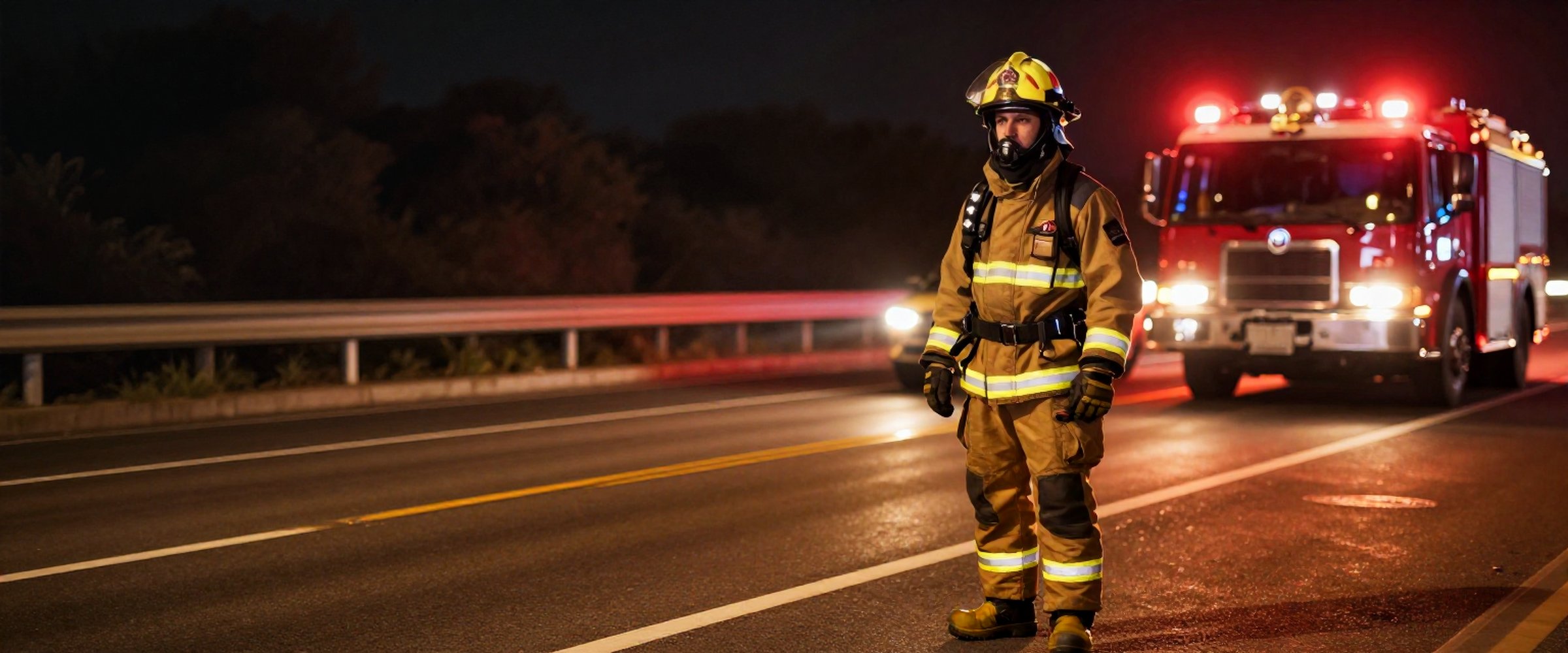
Visibility is the first hazard the risk assessment asks about, and it covers two different moments that call for two different answers: being seen while working structural fire, and being seen while standing on a roadway. NFPA 1970 governs the first. A separate standard, ANSI/ISEA 107, governs the second. This page sets out what each one actually requires, and why turnout gear alone does not satisfy both.
Trim on the turnout ensemble: NFPA 1970
NFPA 1970 (2025) is the consolidated ensemble standard that folded the former NFPA 1971 into a single document; anywhere older references still cite “NFPA 1971,” they mean this requirement. It requires structural coats and trousers to carry reflective trim, and it is specific about where that trim goes and what it has to do once it is there.
A standard pattern, not a manufacturer’s choice
The trim is laid out in a fixed pattern rather than left to styling: a band encircling the coat at the hemline, a band across the chest, a band around each sleeve, and a band around each trouser leg. Manufacturers have some latitude in exactly how the back is finished (two vertical stripes rising from the hem band, or a single horizontal band at the midpoint) and in how the lower sleeve segments are staggered, but the overall layout is consistent from one turnout coat to the next.
The reason for the fixed layout is recognition, not decoration. A pattern that traces the hemline, chest, and both arms outlines a human shape at a distance and in poor light, in a way a single reflective patch does not. It is what lets another crew member, or a driver, identify a firefighter as a person and not as background clutter.
Two properties in one material
Trim is required to combine fluorescent performance for daytime visibility with retroreflective performance for low light and darkness, because no flame-resistant fabric exists yet that is fluorescent across a whole garment. Fluorescence on turnout gear is therefore limited to the trim bands themselves; the shell fabric around them is not fluorescent, which is also why the trim pattern, not the coat color, is what makes a firefighter conspicuous in daylight.
The trim also has to survive the environment it is worn in. NFPA 1970 holds it to the same flame- and heat-resistance requirements as the rest of the ensemble, and its fluorescent and retroreflective performance is evaluated under fireground conditions of heat and wetness, not only in a lab at room temperature.
What this means for the assessment: a coat or trouser without a compliant trim pattern in reasonable condition is a finding, not a matter of preference. Trim that is soiled, delaminated, or missing a band no longer does the job it was placed there to do.
Roadway operations: a different hazard, a different standard
A structural fire and a roadway incident put a firefighter in front of two different backgrounds. Smoke and darkness are what NFPA 1970’s trim pattern is built for. Moving traffic, at highway speed, in a driver’s peripheral vision, is a different problem, and NFPA 1970 was never written to solve it.
NFPA 1500’s Traffic Incident Management provisions, added in the 2018 edition and now carried into the consolidated NFPA 1550, require high-visibility apparel that meets ANSI/ISEA 107 for personnel who are on scene at a roadway incident but not directly exposed to fire, flame, heat, or hazardous materials: pump operators, fire police, support personnel, and command staff among them. There is a deliberate exemption for anyone actively engaged in firefighting or hazmat mitigation, who continue to wear their compliant turnout gear instead; an ANSI vest over an ensemble already built for heat is its own hazard, and the standard does not ask for it.
The same requirement shows up outside the fire service, too: the Federal Highway Administration’s worker-visibility rule (23 CFR 634) requires ANSI/ISEA 107 Class 2 or 3 apparel for anyone working within the right-of-way of a federal-aid highway, and carries the same kind of exemption for firefighters actively engaged in emergency operations.
ANSI/ISEA 107: what it actually covers
ANSI/ISEA 107 is an industrial high-visibility standard, not a fire-service one, and it is built around a different problem than turnout gear solves. It defines garment Types, namely off-road (O), roadway (R) and public safety (P), and Performance Classes within them, with Class 2 or 3 the levels called for on a roadway. A compliant Class 2 vest carries a substantial area of fluorescent background material across most of the garment, not a band of it, plus a defined area of retroreflective material.
That is precisely what a turnout coat does not have. Its fluorescence is confined to the NFPA 1970 trim bands by design, because the shell fabric around them has to be flame resistant first. An ANSI/ISEA 107 vest, in turn, carries no flame-resistance requirement at all; it is built to be seen, not to be worn into fire.
The two standards are not competing ways to solve the same problem. They solve different problems that show up at different moments of the same incident, which is why a department typically needs both: turnout gear built to NFPA 1970 for the fire, and ANSI/ISEA 107 apparel for everyone on the roadway who is not.
What to check
- Does every structural coat and trouser carry an intact, correctly placed trim pattern: hemline, chest, both sleeves, both trouser legs?
- Is the trim itself worn, soiled, or delaminated to the point that its fluorescence or retroreflectivity is compromised?
- Does the department carry ANSI/ISEA 107 Class 2 or 3 apparel, and enough of it, for personnel who work roadway incidents without being directly exposed to fire or hazmat?
- Is it clear to members which standard applies to which role at a roadway incident, so that turnout gear is not mistaken for roadway visibility, or a vest for fire protection?
Standards referenced: NFPA 1970 (2025), which consolidates the former NFPA 1971; NFPA 1500’s Traffic Incident Management provisions, now part of NFPA 1550; ANSI/ISEA 107; and 23 CFR 634. This page describes their scope and intent to support a department’s own risk assessment; it is not a substitute for the standards themselves or for the judgment of the authority having jurisdiction.
General information for fire service decision makers, not a specification and not compliance advice. NFPA and the standards referenced here are the property of the National Fire Protection Association; FireBrigade.com is not affiliated with, endorsed by, or speaking for NFPA.